


One of the main predictions for SEO 2023 is that AI-driven content generation will become standard practice. And whether or not AI is something you want to do for your website, you should still know what your competitors are up to. AI content isn’t just something a few black hat SEOs are doing to cheat the system. At the beginning of 2022, people used AI for non-important content, like e-commerce product descriptions or guest posts. Now people are building full websites on pure AI content.
Contents
Why does AI content boost traffic on your site?
Because:
- It is unique.
- It is cheap, fast to create, and allows you to post up to 5 articles daily to cover all the themes in your topical map.
- It gives Google exactly what it is looking for because most AI content generators use neural networks to detect what keywords Google expects to see in your article.
Of course, not all of the AI-generated websites survived. Some skyrocketed to millions of visitors per month and were completely decimated. But there are more stable sites that are growing 30% month on month and are completely avoiding all the Google update penalties. Let me tell you what they are doing differently.
How to organize your AI content process
They start the AI content process by creating a topical map of all the content they need to produce to become a topical authority in their niche. If they are blasting out five articles per day, they need to have a content roadmap. And once they complete that content roadmap, Google has no choice but to deem them a topical authority in this niche, and that is when the traffic floods in. How to create a topical map I wrote in this article.
The next step is creating an outline for each of the content pieces. We do this by Googling your topic keyword. Open up the first result and look at the H2 and H3 headings on the page. These are all required subtopics of the main theme. And they should be part of our outline. We will also look at the word count to determine how long our article needs.
Now it is time to start using an AI content writer and filling in the blanks between your outline’s heading. Since we have created an outline, the AI content generator already has a framework to start from. So just press the button and start filling in the gaps.
Next, we will do a quick editorial review of our content. AI content tends to make two mistakes, grammar, and facts. So, review your content and check for repeated words or straight-up incorrect information.
Lastly, it is time to scale since you want to hit five daily articles.
What will be the impact of more AI content on the internet? A case can be made about lowering the quality of the search results. Still, with people turning out content so fast, even if the content isn’t amazing, they’re going to become topical authorities, which is the most powerful ranking factor.
ChatGPT was only released a month ago, and SEO specialists have already discovered some insane applications for IT. Applications that are making their website traffic go vertical. Here I am sharing them with you.
Where you can use AI content right now
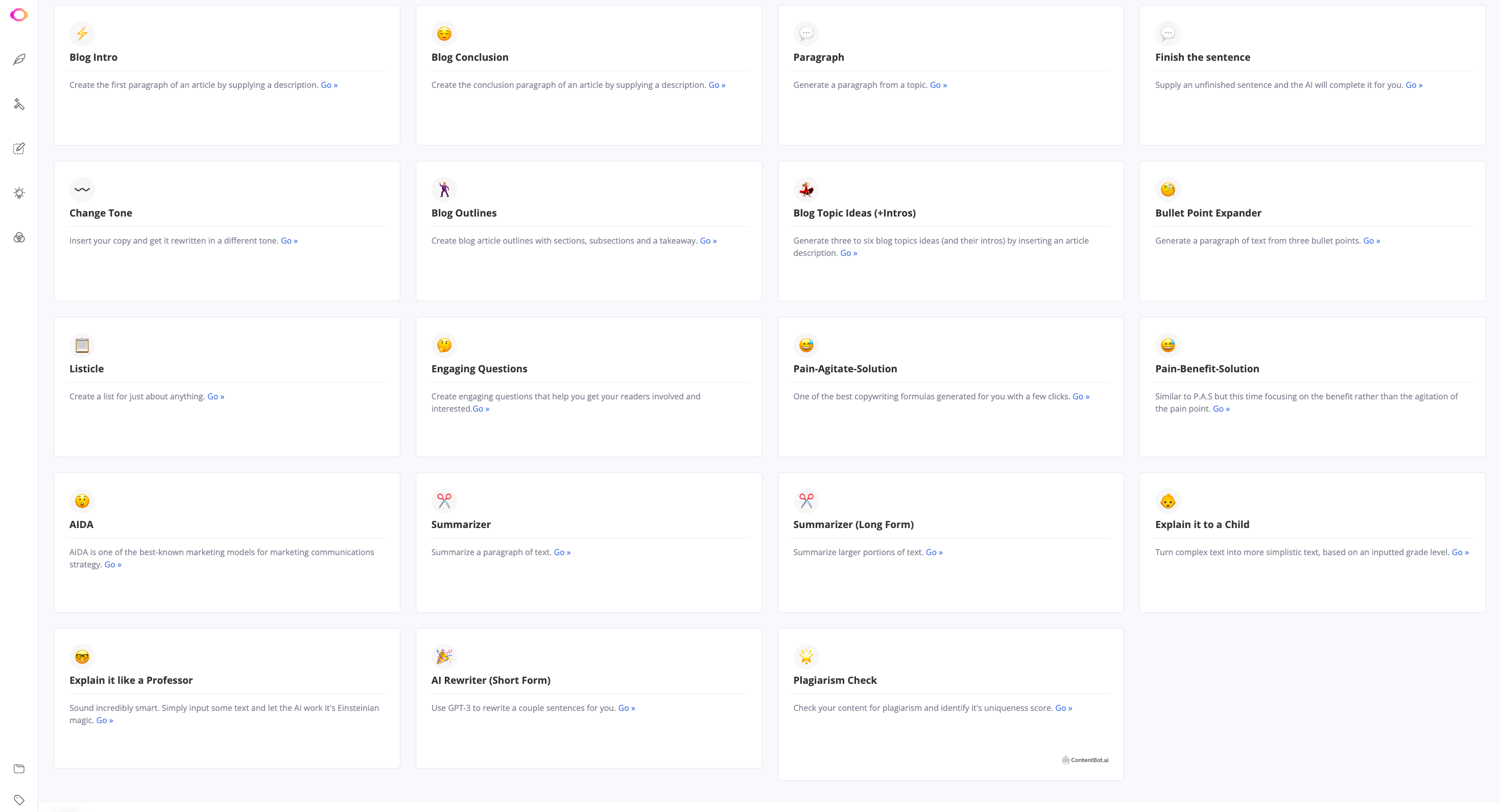
Where you can use AI content right now
Google doesn’t like AI content. Google has said multiple times that AI-generated content is against their guidelines. Can Google detect AI content now? Not quite, at least not algorithmically and not without human intervention, but that may change soon. There are several SEO applications of AI generators. I picked up some of them.
Keyword research
Let’s look at what you can do at ChatGPT to supercharge your SEO strategy. Starting with keyword research. Ask ChatGPT to give you 20 long keywords for a blog about self-service kiosks. Wow, that was easy. But you may want to start with a narrower topic of Bitcoin.
Let’s ask for more keywords. Excellent! These are all great long tails. Let’s ask it to create an article outline for it. Amazing, we got an introduction broken down into four subtitles. And the first subsection of the main body is super logical to the history of the self-service kiosks market.
Composing bait titles and subtitles
Let’s get a better title. Give me a more catchy clickbait title. Now we’re talking about the future of real estate and how Bitcoin is revolutionizing the industry or discovering the benefits of using Bitcoin to buy and sell a property. Seriously, any of these is better than I can do, but maybe you want a keyword-optimized title so you can tell to put bitcoin and real estate at the front.
Generating FAQ section and introduction
Now get ChatGPT to write your introduction paragraph by typing. Next, write a 150-word introduction for answer number five. How about an FAQ section? Easy, tell ChatGPT to make an FAQ section for your article. Let’s say you continue and finish the rest of the article. Let’s make sure it’s SEO optimized, ChatGPT. Provide a list of semantically relevant themes that are missing from and insert your article. Looks like we missed a lot. Our article should have discussed the legal ramifications, notaries, or taxes.
Let’s get a paragraph on the first bullet point of the legal landscape of crypto real estate transactions. Awesome, now drop this in your content. Then we have sentiment. Can you write your content in a positive or negative light? Let’s say you’re writing an article favoring Bitcoin for real estate transactions. Then the following line needs to be helping your argument. Bitcoin’s volatility is more extreme than even the most unstable fiat currencies. Ouch. Just rewrite the line in positive sentiment, there. That’s much better. Bitcoin’s volatility is significantly higher than most unstable fiat currencies, which can be viewed as a positive aspect of cryptocurrency.
Adding schema markup
And you want to add schema markup to your article, which you should. Yo ChatGPT creates schema markup for the same article. I’m not even close to finishing chatting with GPT’s SEO applications, but I want to pause quickly. I want you to realize that we just researched, planned, and wrote an entire SEO-optimized article for free. Yeah, baby. Is this the best piece of content you’ve ever read? Not likely, but you can bet your buns it’s better than entry-level writers.
Creating a topical map
Now let’s get back to more ChatGPT SEO applications. How about creating a topical map? If you want to rank for something like timeshares, you need many timeshare contents. Writing one article isn’t enough. This one I got from the homie, Andrew Sterling Ansley, ChatGPT, provides the ten-year semantically associated questions to what is the value of a timeshare? How does the value of a timeshare change over time? Can a timeshare be sold or is it stuck with the owner? These are great since they’re so closely related. If you write all these articles, you’re much more likely to rank than if you wrote a single one separately.
Keyword clustering
Now, how about keyword clustering? Save listed keywords if you want to know which ones belong in the same article. I got this one from ChatGPT. SEO Facebook group type cluster the following keywords based on relevancy, and here are your keyword groupings. Every article should aim to have a section that is optimized for getting the featured snippet. To do that, you should answer the search query in an NLP-friendly format.
What is an NLP-friendly format? Who cares? ChatGPT knows how to do it. Ask it, and answer the following in an NLP-friendly format what an organic SEO consultant is? And here’s your answer, echos back. The search query uses the word is and gives a concise answer. Now, let’s say you want to promote your article. You’ve written it.
Now, how can you get some eyeballs on it? Ask ChatGPT to write an email letter with a subject line to promote your article. And it’ll spit out an email that you can send to your list or ask it to create a tweet or other social media posts to share your article with hashtags.
You can use it to create highly engaging social media posts that will attract likes and shares to boost your social media presence. Let’s dig into link building and how ChatGPT can be leveraged to do it at scale. Namely guest posting. Hey ChatGPT. Write a 500-word guest post on keyword research in the style of Gary Vee just for some flavor, and voila. Here you go.
SEO research
And here is a clever way to do SEO research. Summarize the main points of this article. Then paste it into the article. Need more clarification, type something like, please clarify AI content SEO in layman’s terms.

Can you post AI content directly to your website?
Can you post AI content directly to your website?
Yes, but with an editing step. Remember, Google doesn’t like AI content, and it’s working on detecting it. Subpar AI algorithms can already be detected. So, human editing and fine-tuning optimization are still required, especially if you are targeting high-competition keywords.
Is it Google’s funeral?
If users can get their questions answered instantly and easily by an AI, why bother sifting through 10 results on page one of Google, some of which are ads? For the past month, I have been digging into ChatGPT, and I finally have an answer to that question.

Just five days since it was released, ChatGPT tracked over a million users. Elon Musk called it “scary good.” What does it do? It’s a free dialogue-based tool driven by artificial intelligence. You can ask it a question or give it a command, such as “write me a thousand-word blog post on the self-service kiosks”. And it does exactly that and does a damn good job too. Scary good.
The crazy thing is that ChatGPT isn’t just a database of information about any subject. It is a neural network trained with a wide set of general knowledge that it can apply to various tasks. It’s similar to how a human being learns. If a human learns carpentry fundamentals, they can apply that knowledge to build a table even though that person was never specifically taught how to do it.
ChatGPT is based off GPT. That’s a generative pre-trained transformer, version 3.5, the latest and greatest of Open AI’s language models. Before I get into all the incredible SEO use cases, we’ll look closely at ChatGPT and explore why Google is terrified of this technology.
The first reason is the ease of use. Look at how easy it is to find answers to your questions compared to the typical Google experience. If I ask ChatGPT, what should I bring to Thailand? Here is a list of nine things I need to pack: passport, visa, clothing, etc. But if I ask Google, I don’t get a quick answer. Instead, I get a list of websites I need to sort through. Which one of these should I trust?
And for many search queries, the top slots will be taken up by ads. Ain’t no ads in ChatGPT. And speaking of getting a faster answer, Google articles are written for SEO. Let’s say you want us to know how many calories are in an apple. So you open up this article in position one of Google and look at how much content you need to get through to find the damn answer. The entire article should just read calories 95, but if it did, it would never rank on Google.
Meanwhile, ChatGPT says, hold my beer, here is your quick answer. ChatGPT is also dialogue based. You can legit have a
conversation with it and ask any question.
Another reason is that ChatGPT can code. For example, you ask it to write PHP code for a mortgage calculator. There you go. Here is a code you can put on your website and have your link bait mortgage calculator in seconds.
There are other arguments for why Google might not be as scared of AI as we think. Some search engine journal articles reveal that OpenAI is the company behind ChatGPT. It is working on a cryptography-based watermarking technology that will leave a footprint on AI-generated content. So it can be detected, but there are simple ways around the watermark detection, too.
There is one huge reason that Google doesn’t consider ChatGPT as a threat. Google is biggest company in the world with over a trillion-dollar valuation. If Google thought ChatGPT was a threat, it would acquire it. And because of this, I stand firm that Google is not dead. So SEO isn’t over, and in fact, the job of the SEO professional just got more powerful than ever.
First, this is a big one GPT still messes up facts a lot. When you are looking for answers, you need to be able to trust your source. One Yahoo Finance article clearly states that ChatGPT doesn’t realize the difference between truth and falsehood. It’ll just make up a story on the spot. No one in their right mind should look at a tweet and believe it. The same way, no one should look at the output of ChatGPT and believe it at face value.
And the problem is, if you don’t know the answer, you have no idea if it’s wrong. And that poses a big threat to user confidence. A big reason for its inability to answer facts correctly is that GPT was only trained on a data set up to 2021. If you ask ChatGPT, it will openly tell you that. This limitation will disappear if they figure out how to train it in real-time.
In comparison, Google has way more data to work with, namely the entire internet. There are 1.14 billion websites on the inner web. Google can crawl and index all of them, adding to its massive database of information at its fingertips. ChatGPT was only trained on 570 gigabytes of the data source to get questions accurately answered from books, Wikipedia research, and websites. And while 570 GB is a lot, it’s hardly 1.14 billion websites worth of data.
As we talked about before, ChatGPT has the advantage that you get a quick answer from one source. That is sometimes a good thing, but sometimes it is not. Imagine you are searching for something like the best backpack for hiking. In situations like this, you want various opinions and reviews.
Google provides you with a curated list of trusted sources to pick what you want to believe. People like freedom of choice. Speaking of reviews, ChatGPT hasn’t them.